
Counterbalance Guides
How to Read a Tax Return When You’ve Never Had To
And What It Can Cost You in a Divorce If You Don’t
What each section of a tax return actually means, explained in plain English — and what it reveals when you’re going through a divorce.
By Kyle Eaton, CFP®, CDFA® · Denton, Texas
What’s Inside
IRS Transcripts — Start HereFiling StatusDependents & Child Tax CreditWages, Stock & Hidden IncomeInterest & Dividends (Schedule B)Business Income (Schedule C & K-1)Capital Gains & CarryoversRetirement DistributionsRental Income & DepreciationAdjustments to Income
DeductionsTax CreditsWithholding & OverpaymentsRefundsUnpaid Tax DebtInnocent Spouse ReliefFrequently Asked Questions
A $90,000 asset sat on page two of a tax return, and nobody in the room noticed. Not the attorney. Not either spouse. It was a capital loss carryover — a line item worth tens of thousands of dollars in future tax savings — and it was about to be divided by accident, or not at all, because no one knew what they were looking at.
That’s not unusual. Most people never read a tax return until they have to. For most of a marriage, one spouse handles the finances, the other signs where they’re told to sign, and life moves on. Then divorce happens, and the document you signed every April becomes one of the most important pieces of paper in your case.
Here’s what I’ve learned from sitting across the table from clients in this exact position: a tax return is not just a summary of what someone earned and what they paid. It’s a map. Every line points to something real — a bank account, a property, a business, a decision made at a specific moment in time. When you know how to read it, a return tells you where money is coming from, what assets exist, and sometimes what’s being kept quiet.
This guide walks through the return from top to bottom in plain language — the way I’d explain it to a client sitting in my office for the first time. No financial background required. And throughout, I’ll answer the question that actually matters: what does this mean for you, in a divorce?
One note up front: I am not an attorney, and I am not a CPA. I’m a financial professional — a Certified Divorce Financial Analyst — and this guide is financial education, not legal or tax advice. Nothing here is a substitute for your own attorney or accountant. My job is to make these concepts clear enough that you know what to ask, what to gather, and what’s at stake before you’re sitting at the negotiating table.
The short version
In a divorce, a tax return is a map of income, assets, and debts — not just a bill. Start by pulling your free IRS transcripts at IRS.gov, then gather three to five years of returns and read them side by side. The sections that matter most are filing status, the income lines (including what’s been removed before you see them), Schedule B for accounts you may not know about, the business income lines (which have their own guide), capital loss carryovers, retirement distributions, Schedule E rental depreciation, and any unpaid balance the IRS can still collect from you after the decree is signed. Everything below walks through those one at a time.
What Are IRS Transcripts, and Why Do I Pull Them Before Reading the Return?
Where to look: Not on the return at all. IRS.gov → Get Transcript. Start here before you open the return itself.
Before I ever sit down with the return itself, I pull transcripts. These are free official records the IRS maintains independently of what was filed — and they often tell me more than the return does.
You can pull your own at IRS.gov right now, for free, without needing a professional to help you. That’s the first thing I tell every client.
How to get your IRS transcripts
- 1Go to IRS.gov and search for “Get Transcript,” or go directly to irs.gov/individuals/get-transcript.
- 2Choose Get Transcript Online. You’ll sign in or create an account through ID.me, which verifies your identity with a photo ID. This is the step that takes most of the 15 minutes.
- 3Once you’re in, pick the transcript type (start with the Wage and Income Transcript and the Tax Account Transcript) and the tax year. You can view, download, or print each one.
- 4Repeat for each of the last three to five years.
- 5If you can’t verify online, you can request transcripts by mail using Form 4506-T — it’s slower, usually a few weeks, but it works.
For any year you filed jointly, your Social Security number is on that return, so you’re entitled to those transcripts — you don’t need your spouse’s permission or knowledge.
If you use a CPA, request your records now — before you need them
If a tax professional prepared your returns, contact them and ask for electronic copies of your returns and any supporting documents they have on file. Keep the request simple — a short email works best:
“Hi [Name], could you send me electronic copies of our tax returns and any supporting documents you have on file? I’d like to have them for my records. Thank you.”
That’s it. Don’t mention the divorce. Tax professionals who prepare returns for couples can become uncomfortable once a divorce enters the picture — not out of any wrongdoing, but because they’re suddenly unsure whose interests they represent. A routine records request made before that conversation happens is far more likely to get a quick, complete response. And having it in writing, by email, means you have documentation of what was requested and when.
The five types worth knowing
- →Wage and Income Transcript — Shows what employers, banks, and other companies reported directly to the IRS — independent of what was actually filed. This is the one I reach for first when income doesn’t add up.
- →Tax Return Transcript — A summary of the actual filed return for that year.
- →Tax Account Transcript — Every payment made, every penalty assessed, every amendment filed, and any remaining balance. The full account history.
- →Record of Account — Combines the return and account transcripts into one document.
- →Verification of Non-Filing — Confirms no return was filed. More useful than it sounds if you suspect returns were skipped.
Why transcripts matter in a divorce
The Wage and Income Transcript shows what the IRS actually received from third parties — employers, banks, brokerages — regardless of what your spouse reported. It can catch income that was never disclosed, reveal accounts you didn’t know existed, and surface tax debt that becomes a marital liability.
From My Practice
I worked on a case involving a 401k that had been opened before the marriage. The wife had contributed to it for a couple of years prior to getting married, and continued contributing afterward. The problem was tracing exactly how much of the balance was separate property — hers before the marriage — versus how much had grown from contributions made during the marriage.
We had one account statement, which helped, but it wasn’t enough on its own. We didn’t have the full history of contribution statements needed to show, year by year, how much she had put in during the marriage.
So we pulled her IRS wage transcripts. Wage transcripts show reported wages and withholdings for each year — including retirement plan contributions. Using those transcripts alongside the one statement we did have, which broke out employee versus employer contributions, we could reasonably estimate what the employer had likely contributed in the years we didn’t have statements for.
Piecing those two sources together, we were able to build a defensible estimate of what portion of the 401k represented separate property brought into the marriage, and what portion had accumulated as a marital asset. It wasn’t a perfect reconstruction — no one had the complete paper trail. But it was reasonable, well-documented, and defensible.
This is one of the most practical uses of an IRS transcript in divorce. When account records are incomplete or missing entirely, the transcript can fill in gaps the missing statements left behind — turning what looks like an unsolvable tracing problem into a workable estimate.
A note on the “where to look” lines throughout this guide: they refer to the current Form 1040. The IRS renumbers lines every few years, so an older return may be off by a line or two. The form names (Schedule B, Schedule D, Form 8606) stay the same.
One way money gets parked out of sight
The account transcript can reveal something I see more often than most people expect: deliberate over-withholding. Someone adjusts their paycheck so too much tax is held back all year — or makes extra estimated payments, the quarterly tax payments self-employed people send in — and that money quietly builds up as a credit with the IRS. Nobody sees it. When the return is filed after the divorce is finalized, they collect it all back as a refund. Only they receive it.
It’s simple, it’s legal, and it works unless someone knows to look for it.
Here’s the Texas piece. That refund is still community property. Texas has no legal separation and no “date of separation” cutoff — the community estate keeps running until the decree is signed, or until the two of you sign a partition agreement converting community property to separate. Short of one of those, a refund that comes from income earned during the marriage belongs to both spouses, even if it arrives after you’ve moved into separate homes and even if only one name is on the direct deposit. So the question isn’t whether you’re entitled to half of it. You are. The question is whether you know it exists, and whether the decree accounts for it.
Red flag — Married Filing Separately
If your spouse filed their own separate return in any year — not jointly with you — those transcripts are completely locked to their Social Security number. You cannot access them on your own, even though you were married that year. A spouse who pushed for separate filing in the years before a divorce may have done so with exactly this in mind. Legal discovery — the formal process in which your attorney can compel the other side to produce documents — is the only legitimate path to those records. There’s also a Texas twist that works in your favor: a separate return in a community property state has to show half of your income on it. More on that in the filing status section below.
Why I want three to five years of returns — not just one
One year never tells the whole story. Patterns only show up when you line years side by side.
- →Does income stay consistent, or does it drop right when divorce proceedings start?
- →Did a deduction appear or disappear around the time of separation?
- →Did withholding spike in a particular year for no obvious reason?
- →Who was claiming the children, and did that change?
- →Did a business suddenly start losing money right when it needed to?
What Does Filing Status Tell You in a Divorce?
Where to look: Form 1040, top of page 1 — the Filing Status checkboxes. Form 8958 if either spouse filed separately.
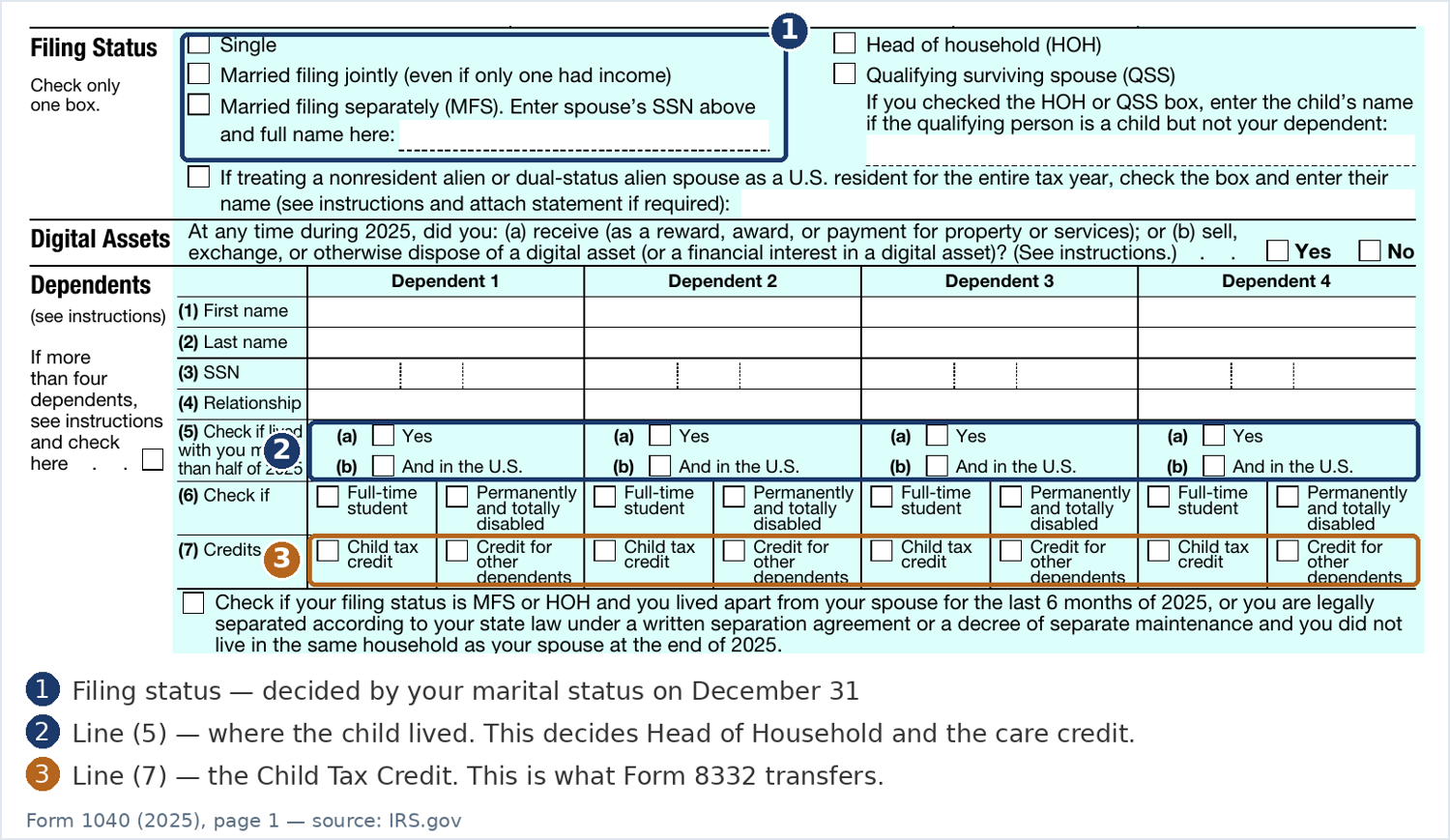
The first thing I look at after the name and Social Security number is filing status. It’s a single checkbox, but it controls the tax rates, the standard deduction, and eligibility for nearly every credit and deduction on the return.
The five options
- →Single — Unmarried, or legally divorced as of December 31 of that tax year.
- →Married Filing Jointly — Married and combining both incomes on one return.
- →Married Filing Separately — Married but each filing their own return.
- →Head of Household — Unmarried, supporting a qualifying child, and paying more than half the household costs. Comes with a meaningfully higher standard deduction than Single.
- →Qualifying Surviving Spouse — For widows and widowers with dependent children in the two years following a spouse’s death. (If you’re reading a guide about divorce, this one is not a viable option for you. Let’s keep it that way.)
A Married Filing Separately return in the years before a divorce is always worth a second look. Sometimes it’s just a CPA’s math. Sometimes it’s the first visible sign that one spouse started separating the finances before anyone said the word divorce.
Married Filing Separately works differently in Texas
In a community property state, a spouse who files separately doesn’t get to report only their own income. Each spouse is required to report half of all community income — including the other spouse’s wages — and attach Form 8958 showing how it was split. A Texas MFS return should have your income on it, and yours should have theirs.
Two things follow. If your spouse filed separately and their return doesn’t allocate your income, the return is wrong — and that’s a question your attorney can ask in discovery. And if your own preparer filed you separately without a Form 8958, the problem is on your return too.
There’s one exception: if you lived apart for the entire year and neither of you shared earned income with the other, federal law (IRC §66(a)) lets each of you report only your own earnings.
The December 31 rule — and the Head of Household opportunity
The IRS determines your status based on one date only: December 31. If your divorce wasn’t final until January 2nd, you’re considered married for that entire year. There is one exception that fits the separation year exactly: if your spouse did not live in your home during the last six months of the year, you paid more than half the cost of keeping it up, and a child lived with you more than half the year, the IRS treats you as unmarried for that year and lets you file as Head of Household instead of Married Filing Separately.
Head of Household is the status I see missed most often after a divorce. People file as Single when they actually qualify for a higher standard deduction. If you had a child living with you and paid more than half the household costs, it’s worth checking — even if you signed Form 8332 and the other parent claimed the child that year. The release moves the child credits; it does not move Head of Household.
Who Gets to Claim the Children? Dependents, Form 8332, and the Child Tax Credit
Where to look: Form 1040, page 1, the Dependents table. Form 8332 if a release was signed. Schedule 8812 for the Child Tax Credit.
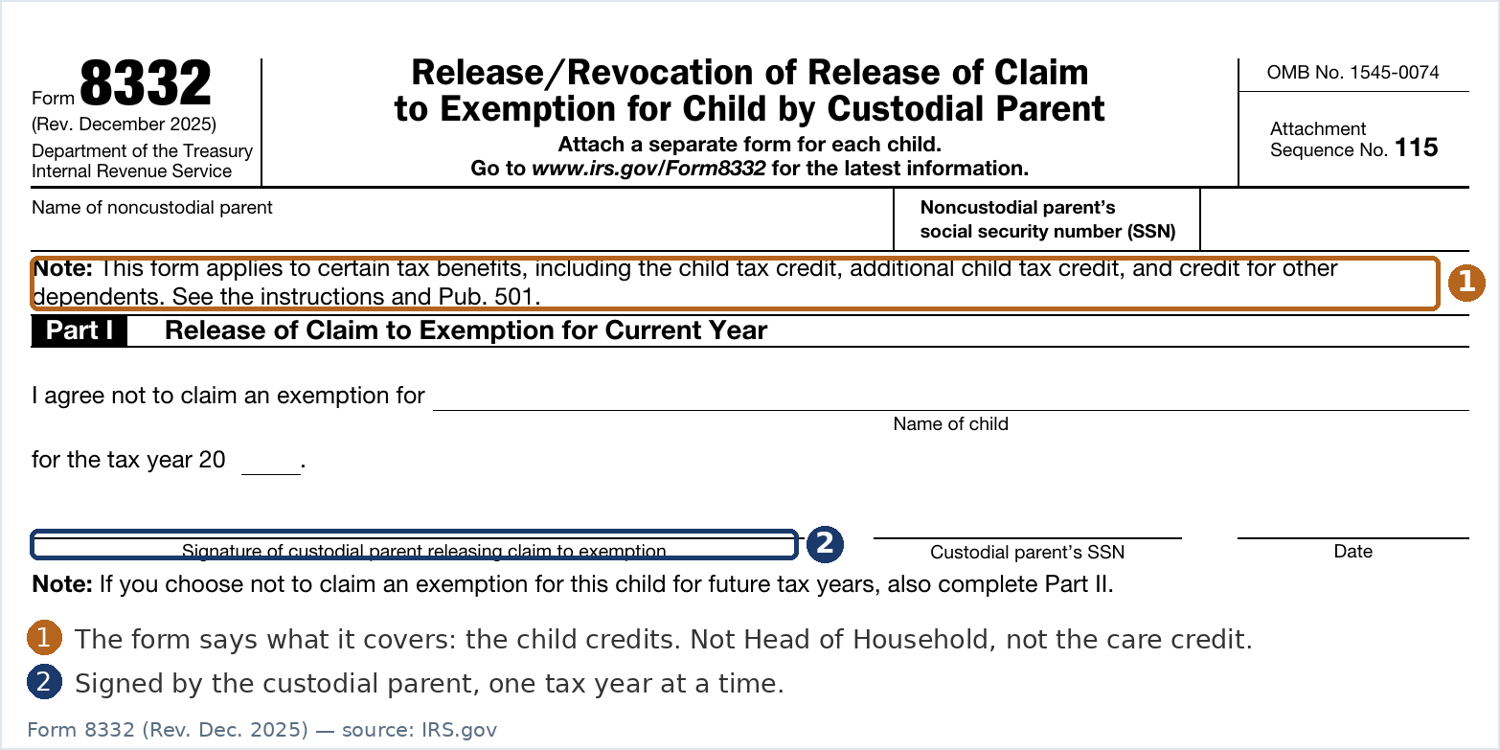
Claiming a child matters because it unlocks real money — most notably the Child Tax Credit, worth up to $2,200 per child in 2026. The old dependency exemption itself is gone (it’s been $0 since 2018 and is now permanent), so what’s really being claimed is the set of credits tied to the child. In a divorce, that right should be treated as a financial asset and negotiated like one. But “claiming the child” is a bundle of separate tax benefits, and only some of them can be traded. That distinction is where settlements go wrong, so it gets its own box below.
Definition — Dependent
A dependent is a child or qualifying person you financially support. Claiming them determines who gets the tax credits and deductions tied to that person — not just a name on a form.
Who actually gets to claim the child?
The IRS default is simple: the parent the child lived with for more nights during the year gets to claim the child. A divorce decree doesn’t override this — and I’ve seen more than one case where a non-custodial parent claimed a child because the decree said they could, then got denied because the right paperwork wasn’t attached.
That paperwork is Form 8332 — a signed release from the custodial parent (the one the child lives with most of the year) giving the other parent the right to claim the child for a specific tax year. The form still carries its old name, “Release of Claim to Exemption,” but since the exemption is now zero, what it actually transfers is the Child Tax Credit and the other credits that follow the claim. Without it, the IRS doesn’t care what the decree says. The release can be signed for one year at a time, multiple years at once, or traded as part of a settlement.
What Form 8332 transfers — and what it doesn’t
Goes with the release, to the non-custodial parent: the Child Tax Credit, the Credit for Other Dependents, and the education credits for that child. (Not a dependency exemption — there hasn’t been one to transfer since 2018.)
Stays with the custodial parent no matter what: Head of Household filing status, the Earned Income Credit, the Child and Dependent Care Credit, and the exclusion for employer dependent-care benefits. The IRS ties these to where the child actually lived, and no form or decree can move them.
So when a settlement says one parent “claims the kids,” ask which benefit is meant. A custodial parent who signs Form 8332 can still file as Head of Household using that same child — and the non-custodial parent cannot, even with the release in hand.
The version of this I see most often is the one where everyone followed the rules and it still went wrong: the decree says Dad claims the kids in even years, Dad claims them, and the IRS rejects his return because Mom’s went in first with the kids on it and no Form 8332 was ever signed. The decree was right. The paperwork wasn’t there. That’s a six-month cleanup in a case that was supposed to be finished.
Same child on two returns
The IRS matches Social Security numbers. If the same child appears on two different returns in the same year, the IRS will flag it. One parent will lose the credit. Only one can legally claim it per year.
What Does the Income Section Hide? Wages, Stock Compensation, and What’s Already Been Subtracted
Where to look: Form 1040, lines 1a–1z (wages), and the W-2 behind them — box 12 is where retirement and HSA contributions show up.
The income section is where I spend a lot of time — not because the numbers are hard to read, but because what’s not there is often as important as what is. The return shows a net number. Certain things have already been subtracted before you ever see the figure.
What’s already been removed from the number you see
- →401(k) and retirement contributions — Subtracted before taxes. Never shows up as income. The W-2 is where this becomes visible.
- →Health Savings Account (HSA) contributions — Including whatever the employer contributed, which won’t appear as income anywhere on the return.
- →Flexible Spending Account (FSA) — Reduces taxable wages before they’re ever reported.
To see the real compensation picture, you need the W-2 — the annual wage statement an employer sends to both the employee and the IRS — or the Wage and Income Transcript. Not just the return.
Where stock compensation gets complicated
This is the area where I’ve seen some of the biggest discrepancies between what a spouse believes they know and what’s actually there. Stock compensation — restricted stock units, options, deferred pay — doesn’t always show up clearly on the return. And when someone is trying to minimize what they appear to have, it’s one of the first places to look.
Definition — Stock Options and RSUs
A stock option is the right, granted by an employer, to buy company shares at a fixed price for a set number of years. It’s worth something only if the stock rises above that price. Options usually vest on a schedule — meaning the employee earns the right to use them over time — and are exercised when the employee actually buys the shares. Nothing shows up on the return until exercise; the grant itself is invisible. A restricted stock unit (RSU) is simpler: a promise of actual shares delivered on a vesting schedule. RSUs appear on the W-2 as wages in the year they vest. Both are compensation that was earned during the marriage, whether or not it has turned into cash yet.
From My Practice
I had a client whose husband was a former executive at a publicly traded company. He had received stock option grants during his time there. Her concern was that those shares still existed but weren’t showing up in any financial disclosure.
We pulled the tax return and found dividend income — reported as investment income, not wages. That distinction told us everything we needed to know. If those shares were still unvested options, there would be no dividends. Dividends meant the stock had already vested, already converted, and was sitting in a personal brokerage account as individually held shares. By taking the dividend amount and dividing it by the company’s known per-share dividend, we could calculate approximately how many shares he held — and tie that number back to his original grant schedule.
Here’s the part that mattered most, though. Once she had that information, she had a choice to make. She could have fixated on it — pushed for forensic accounting, more discovery, more attorney time, more cost out of her own pocket. Instead, she used it as a data point and moved on to the issues that actually mattered to her in closing the divorce. The return didn’t just show her what was there. It gave her enough certainty to stop spending energy on what she couldn’t trust — and redirect it toward what she could control. That’s often the real value of this work.
Deferred compensation — the other invisible pay
Pay set aside now and received later. Not taxed — or visible on the return — until it’s actually paid out. Like unvested stock, it’s compensation earned during the marriage that the return won’t show. The employer’s grant schedules and plan statements are the documents that make all of it visible.
Wages only = employee income
The wages line captures W-2 income only. If your spouse works as a contractor or owns a business, that income lives on Schedule C or arrives on a Schedule K-1 — an entirely different part of the return, covered in the business income section below and in its own guide. A return showing low or no wages doesn’t mean low income.
How Does Schedule B Reveal Accounts That Were Never Disclosed?
Where to look: Schedule B, Parts I and II — one line per bank, brokerage, or fund. Totals flow to Form 1040, lines 2b and 3b.
Banks and investment accounts report interest and dividends directly to the IRS. That information lands on Schedule B, listed by institution name. (A schedule is just an attachment to the main Form 1040 that breaks out one category in detail.) I treat this section less like a math problem and more like a reconnaissance exercise.
Every institution listed gets matched against statements I actually have. If a bank name shows up that I don’t have a statement for, that’s an account to find. And if the interest amount seems too large for the accounts I do know about, I work backward. Using that year’s typical interest rates, I estimate what balance would have produced that much interest. When the implied balance doesn’t match what’s been disclosed, that’s a conversation worth having.
The same logic works for dividends. The stock option case in the income section above started on Schedule B. It showed dividend income from a company whose shares hadn’t appeared in any disclosure. Dividends only come from shares that actually exist. So the dividend amount, divided by the company’s per-share payout, told us roughly how many shares were sitting in an account we hadn’t been shown.
Separate property income — a nuance worth understanding
Just because an account is technically separate property — owned before the marriage — doesn’t mean the income it generates is also separate. In Texas, interest or dividends earned during the marriage from a separate account are generally community property, even though the underlying account stays separate. There’s a related issue, too. Because that income is community, the tax on it is a community expense — no claim there. But if community money paid the tax on a separate-property gain — say, the capital gains tax when a premarital asset was sold — that can create a reimbursement claim back to the community estate.
See also: Community vs. Separate Property in Texas: What’s Really Yours
Where Does Business Income Land on the 1040 — and Why Does It Get Its Own Guide?
Where to look: Schedule 1, line 3 (Schedule C business income) and Schedule E, Part II (income from partnerships and S-corporations, via Schedule K-1). Both flow to Form 1040, line 8.
If your spouse owns a business, the income from it reaches the personal return in one of two ways. A sole proprietor or a one-owner LLC reports it on Schedule C. An owner of a partnership, a multi-owner LLC, or an S-corporation receives a Schedule K-1 from the business, and that number lands on Schedule E. A C-corporation is different again: the owner shows up on the 1040 only through salary and dividends, and the business keeps its own return entirely.
What those numbers have in common is that none of them is verified by anyone outside the business. A W-2 is confirmed by an employer. A business return is prepared by the business. The figure that reaches the 1040 is a net number — income after expenses — and both halves of that subtraction are shaped by decisions the owner made. It can be accurate. It can also be made to look smaller than it is, legally, right when a support calculation or a settlement is being negotiated.
That’s a different kind of reading, and it needs the business return itself — not just the line that reaches the 1040. So it gets its own guide: How to Read a Business Tax Return in a Divorce, covering Schedule C, K-1s, S-corporations, and C-corporations, with the cases that go with each.
The one thing to take from this section
Any time a Schedule C figure or a K-1 appears on the return, ask for the full business return behind it and three to five years of the business’s bank and credit card statements. The personal return tells you a business exists. Everything else is in the business’s own documents.
What Is a Capital Loss Carryover, and Why Is It the Asset Most Often Left on the Table?
Where to look: Schedule D and Form 8949. The carryover appears on Schedule D, lines 6 and 14 — and in full on the Capital Loss Carryover Worksheet, which you have to ask the preparer for.
Schedule D shows sales of investments — stocks, real estate, business interests. It’s backed up by Form 8949, which lists each individual transaction. I go through these line by line, because the story of what was sold and when is often as important as how much.
Definition — Capital Gain
The profit from selling something for more than you paid. Only the profit is taxed — not the full sale price. Assets held over a year qualify for lower long-term rates. Assets held under a year are taxed at the same rate as ordinary income.
Capital loss carryovers — what gets missed more than anything else
When investment losses exceed gains, the IRS caps how much can offset ordinary income at $3,000 per year ($1,500 for a Married Filing Separately return). The rest carries forward — year after year — until it’s fully used up. A large carryover is real future tax savings. It’s a financial asset, and it needs to be addressed in the settlement like one.
From My Practice
This is the case I opened with. The return showed $90,000 in capital loss carryover. The attorney handling the case never raised the question of how it would be treated in the divorce. Nobody asked. That carryover was going to save someone tens of thousands of dollars in future taxes — and it nearly got divided by default, or not at all, because no one recognized it for what it was.
How carryovers are split depends on your state
Under Treasury Regulation §1.1212-1(c), when a couple stops filing jointly, the carryover is allocated to whichever spouse’s losses created it.
In Texas (community property): Losses in a community property account belong to both spouses equally — so a carryover built during the marriage generally splits 50/50 going forward, unless it came from one spouse’s separate property.
In common law states: The loss stays with whoever’s name is on the account that generated it. No automatic split.
One thing that matters for how the decree is written: a capital loss carryover is one of the few assets a divorce court can’t simply award to one spouse. For federal tax purposes, the regulation decides who gets it — not the decree. What the decree can and should do is name the carryover, state its value and how it was allocated, and offset it with other property if one spouse ends up with more of it than the division intended. When the decree is silent, it isn’t just that the regulation decides by default — in practice, the odds go up significantly that one spouse’s preparer carries the entire loss forward on that spouse’s return and the other spouse never knows it existed. Naming it in the decree is what keeps that from happening.
What Do Retirement Distributions Show on a Return — and What Don’t They?
Where to look: Form 1040, lines 4a–4b (IRAs) and 5a–5b (pensions and annuities). One Form 1099-R per account behind those totals.
When money comes out of a retirement account — a 401(k), IRA, or pension — the plan sends a Form 1099-R, the statement that reports the withdrawal, and it gets reported as income. This section looks simple. It often isn’t.
The lump-total problem
The number on the return is one combined figure — all retirement withdrawals added together. If someone has three IRAs and a pension all making distributions, it’s one number. You can’t tell how many accounts are behind it without the actual 1099-R forms. And the balance in each account — what’s still there — doesn’t appear on the return at all.
The account balance is not on the return
Retirement accounts are often the largest asset in a marriage — and the return only shows what came out, not what’s still in there. The actual balance is only visible on the account statement. Getting those statements is not optional. It’s essential.
See also: Retirement, Pensions & Stock Options: The Money Most Likely to Slip Away
What Is Depreciation Recapture, and Why Does It Follow a Rental Property Into a Divorce?
Where to look: Schedule E, Part I — one column per property. Depreciation is line 18. The total ever taken is on the preparer’s depreciation schedule (Form 4562 and its worksheets).
Schedule E shows rental income after expenses. Like business income, it’s a net number — not what the property actually brought in, but what’s left after deductions. The property itself may be worth far more or far less than what this number suggests.
Depreciation recapture — the tax bill nobody sees coming
Definition — Depreciation Recapture
Depreciation is a yearly deduction for the wear on a rental building. Recapture is the IRS collecting on all of those deductions at once when the property sells. Every dollar ever deducted is taxed on the way out, at a rate up to 25%. It’s a bill that builds silently for as long as the property is owned.
Two properties with identical market values today are not equal in a divorce if one carries years of accumulated depreciation. The one with the higher depreciation has a larger built-in future tax bill — and the spouse who receives it receives that liability too.
When a spouse moves into the former rental
One of the most common scenarios I see: one spouse moves into what used to be the rental after separation. The income disappears from Schedule E. People assume the property is now a personal residence and the tax picture resets. It doesn’t.
All the depreciation from the rental years still comes due when the property is eventually sold. That’s true even if it’s been a primary home for years by then. The standard home sale exclusion does not protect against this.
From My Practice
I worked on a collaborative divorce where the couple had accumulated forty-five rental properties over roughly twenty years. On the surface it looked like a straightforward asset division — a large one, but straightforward. Nobody in the room had run the depreciation recapture calculation before we sat down together.
Real estate depreciates over 27.5 years for tax purposes. Every year you own a rental property, you claim a deduction for that depreciation. Every one of those deductions is waiting for you on the back end when the property sells. Multiply that across forty-five properties held for two decades, and the number gets large fast.
When I ran it, the total tax liability from depreciation recapture came to approximately $400,000. That figure had to be factored into how every property was valued and how the division was structured. Two properties with the same market value are not the same asset if one carries ten years of accumulated depreciation and the other carries twenty. The attorneys hadn’t accounted for it — not because they weren’t thorough, but because this is a tax calculation, not a legal one. Once we put the number on the table, we worked through the adjustment collaboratively and the settlement reflected the real after-tax picture. Without that step, one spouse would almost certainly have ended up holding significantly more liability than the other without either of them knowing it.
What Are Above-the-Line Deductions — and What Is the IRA Trap That Causes Double Taxation?
Where to look: Schedule 1, Part II (lines 11–26). Form 8606 for nondeductible IRA basis. The total lands on Form 1040, line 10.
Below the income section are specific deductions taken before the main deduction calculation. These reduce Adjusted Gross Income — a number that matters because it determines eligibility for many credits and programs.
Definition — Adjusted Gross Income (AGI)
Your total income minus certain allowed adjustments. A lot of things in the tax code — credit eligibility, deduction limits, subsidy qualification — are based on where your AGI lands, not your raw income.
IRA contributions and the Form 8606 problem
Definition — Basis
Money that has already been taxed. In an IRA, basis is the total of contributions that never got a deduction going in — so it shouldn’t be taxed again coming out. The IRS only knows your basis if someone tracked it on Form 8606. No form, no basis, and the whole withdrawal gets taxed.
Most people assume that money going into an IRA always gets a tax deduction. That’s not always true. Depending on income level and whether someone has a retirement plan at work, some IRA contributions get a deduction and some don’t. The ones that don’t are called nondeductible contributions — meaning the money went in after taxes were already paid on it.
That distinction has to be tracked carefully, because it determines whether you’ll be taxed again when the money comes out. Form 8606 is the IRS form that tracks it — a running record that says: this portion of the IRA has already been taxed, don’t tax it again.
Without Form 8606 on file, the IRS has no record that any of the IRA was funded with after-tax money. When withdrawals eventually happen, the IRS assumes every dollar is taxable. The account owner gets taxed twice on the same money. That’s double taxation — and it’s entirely avoidable if someone knows to file the form.
From My Practice
A friend came to me after her divorce was already final. Her attorney was thorough, but nobody on the legal team had asked about her IRA — and there was no reason they would have known to.
What we found was this: her husband had been making contributions to her IRA for years while she was a stay-at-home mom. Some of those contributions were nondeductible — meaning they went in with after-tax dollars and were supposed to be tracked on Form 8606 so she wouldn’t be taxed on that money again when it came out. She didn’t know this. Her attorney didn’t know to ask.
Post-divorce, she received a portion of her ex-husband’s 401(k) as part of the settlement. To meet immediate liquidity needs, she rolled those funds into the same IRA. What she didn’t realize was that she had just mixed deductible and nondeductible money in the same account — pre-tax 401(k) dollars sitting alongside after-tax nondeductible contributions that were already there.
Think of it like cream in coffee. Once it’s mixed, you can’t unmix it. The IRS doesn’t let you designate which dollars come out first. Every distribution she takes going forward has to be calculated pro-rata — a portion taxable, a portion not, based on the ratio of pre-tax to after-tax money in the account at the time. The tax benefit from those nondeductible contributions doesn’t disappear, but it gets spread across every dollar she ever withdraws, diluted across the full account balance.
She now has to file Form 8606 every single year — not because she’s contributing anything new, but because the IRS requires ongoing tracking of that after-tax basis. That record-keeping obligation is entirely on her. If she or her CPA ever loses track of it, she risks being taxed twice on money that already had taxes paid.
The cleanup options are limited once you’re in this situation. If the nondeductible amount is small enough, a Roth conversion can isolate it without a meaningful tax bill. The other path — if she returns to work or establishes a solo 401(k) — is to roll the pre-tax portion back into an employer plan. Under IRC §408(d)(3)(A)(ii), when IRA funds roll into an employer plan, only pre-tax dollars can go — the nondeductible contributions are prohibited from following. They get left behind, effectively isolated, where they can eventually be managed or converted separately. Michael Kitces has written extensively on this strategy at kitces.com for anyone who wants to go deeper on the mechanics.
None of this was visible until someone looked. She came to me after the decree was signed. A conversation during the divorce process — when the IRA and the 401(k) were both being discussed as assets — would have changed how the rollover was structured and potentially avoided the problem entirely.
Two IRAs with the same balance aren’t equal
If one IRA has documented nondeductible contributions and another doesn’t, the one with the documented basis is worth more in after-tax dollars. A settlement that splits retirement accounts purely by balance, without looking at the tax character of each, isn’t actually splitting them equally.
Student loan interest — a signal to check the loan date
When I see a student loan interest deduction, I immediately want to know when the loan was taken out. The origination date determines whether it’s separate or marital debt — and in Texas, even if marital money paid down a spouse’s separate student loan during the marriage, the Family Code (Tex. Fam. Code §3.409) specifically bars a reimbursement claim for that. It surprises a lot of people.
Alimony paid
For divorce agreements finalized before January 1, 2019, alimony paid is deducted here by the payer and is taxable income to the recipient. For agreements finalized in 2019 or later, the rules changed entirely — no deduction, no taxable income. The date of the agreement controls which rules apply.
Retirement contribution timing
A self-employed person can make their retirement contribution as late as the tax filing deadline, including extensions. That means someone can wait until after a support calculation is finalized, then decide how much to contribute — directly affecting what their income looks like for that year. Unusual spikes in retirement contributions around the time of a support hearing are worth asking about.
Standard vs. Itemized Deductions: What Do the Line Items Reveal?
Where to look: Form 1040, line 12. Schedule A if itemized.
Every taxpayer chooses between a standard deduction — a flat amount based on filing status — or itemized deductions, where actual specific expenses are listed out. You use whichever is larger. For most people post-divorce, the standard deduction wins. But when someone itemizes, the line items themselves are worth examining.
From My Practice
In one case I worked on, the property taxes being deducted were higher than they should have been given what I knew about the property. I started digging, and we discovered the homestead exemption had never been filed. In Texas, homeowners who use a property as their primary residence qualify for a significant property tax reduction — but you have to apply for it. It doesn’t happen automatically, and a lot of people don’t know that.
We went back and filed retroactively for two prior years, which is allowed under Texas law. The result was a refund of overpaid property taxes that went back into the marital estate. It was money nobody knew was sitting there.
Which Tax Credits Go to Which Parent After a Divorce?
Where to look: Form 1040, lines 19 and 20. Schedule 8812 (child credits), Form 2441 (dependent care), Form 8863 (education).
Credits are different from deductions. A deduction reduces the income you’re taxed on. A credit reduces the actual tax you owe, dollar for dollar. In a divorce, both parents need to understand what each credit is, who it follows, and whether it’s being addressed in the settlement.
In practice, the care credit is the one that gets forgotten. Both sides spend their energy negotiating who claims the kids, and nobody asks who is actually paying the daycare. The parent who paid it finds out the other parent claimed the credit, and now there’s an amended return in a divorce that was supposed to be over.
Child and Dependent Care Credit
This credit does NOT follow the dependency claim
The Child Tax Credit follows whoever claims the child as a dependent. The Child and Dependent Care Credit does not. It goes to the parent who actually paid the childcare expenses and has the child living with them. A settlement that resolves who claims the child may not automatically resolve this credit. Both need to be addressed separately.
Education credits — when parents split the tuition
Education credits follow the dependency claim — not the payment
Only the parent who claims the student as a dependent can use the credit — even if the other parent is paying tuition. If parents are splitting college costs, this needs to be clearly spelled out in the settlement. The money flow doesn’t determine who gets the credit. The dependency claim does.
What Can Withholding and Estimated Payments Hide?
Where to look: Form 1040, lines 25–26 — withholding, estimated payments, and the amount applied from last year’s refund. Line 33 is the total.
This section shows all the money already sent to the IRS during the year. It gets there three ways: paycheck withholding, quarterly estimated payments, or a prior-year refund applied forward. It’s one of the sections people skim past, and one of the places I look most carefully.
This is where the parked-money pattern from the transcripts section shows up on the return itself. The first thing I check on a separation-year return is whether withholding jumped — same paycheck, more of it going to the IRS.
- →Does withholding match income? — Unusually high withholding on modest wages is a flag. Money may be deliberately building up as a future refund.
- →Spikes in estimated payments near separation — A jump in quarterly payments right around the time of separation is worth asking about
- →Refunds applied forward instead of taken as cash — The money never visibly lands anywhere. It gets absorbed into the following year’s return.
- →Year-over-year consistency — Changes in either direction without a clear explanation deserve one
Where Did the Tax Refund Actually Go?
Where to look: Form 1040, lines 34–36 — refund amount, direct-deposit routing and account numbers, and any amount applied to next year.
A refund isn’t just a number. It’s a real event. Money left the IRS and went somewhere. I treat it like any other financial transaction — there’s a source, there’s a destination, and that destination needs to be accounted for.
And in Texas, that refund is community property until the decree or a partition agreement, no matter whose account it lands in (see the transcripts section). That’s why tracing it matters.
When I trace a refund, the question I’m really asking is simple: did this money land somewhere both spouses could see it? If the answer is the joint checking account, we move on. If the answer is an account one spouse didn’t know existed, the refund was never the point. The account is.
- →Was the refund received as cash or applied forward? — Applied forward means it never landed anywhere visible
- →What account did it go to? — A refund deposited to an account you didn’t know existed is a gap worth following
- →Direct deposit routing information — Bank account and routing numbers for refund deposits sometimes appear in transcript records
- →Large refunds timed near separation — Worth asking specifically where the money went and why it’s not accounted for
Why Doesn’t the Divorce Decree Protect You From the IRS?
Where to look: Form 1040, line 37 (amount you owe). Then the IRS Account Transcript to see whether it was actually paid.
A balance due on a return doesn’t automatically mean it was paid. The return shows what was owed — not whether the IRS actually received the money. I always cross-check the account transcript before drawing any conclusions.
The divorce decree doesn’t bind the IRS
A settlement can assign responsibility for a tax debt to one spouse. The IRS doesn’t care what the settlement says. Both spouses on a joint return remain fully liable for the entire amount — the IRS can come after either one. The decree is only enforceable between the two of you, not against the IRS.
From My Practice
I worked with a couple going through a collaborative divorce where the husband was a physician earning approximately $1.5 million a year. At that income level, estimated tax payments are made throughout the year — but even with those payments, a balance can still be owed when the return is filed. That’s common at high incomes, and it’s not a problem in itself.
April 15th came around, an extension was filed, and the doctor made a single payment toward the prior year’s liability. It wasn’t enough to cover what was owed. Throughout the collaborative process, we flagged this more than once. The outstanding balance was there in the documents. It wasn’t hidden.
But it wasn’t real to the wife until we were nearly done.
As we were finalizing the settlement, she understood for the first time that she might be personally responsible for approximately $60,000 — her share of the outstanding tax liability from a joint return she had already signed. At that point in the process, that kind of number doesn’t just affect the math. It affects the whole conversation.
Your situation may not involve those dollar amounts. But the dynamic is the same at any income level. If your household has been filing extensions and the prior year’s return hasn’t been fully paid, there may be a liability sitting in the background that hasn’t been priced into the settlement yet. It needs to be.
Before any settlement is finalized, make sure you know the full tax picture — not just what was filed, but what was paid, and what is still owed.
What Is Innocent Spouse Relief, and When Does It Apply?
Where to look: Not on the return. Form 8857 is the request. The Account Transcript shows what’s still owed.
The last section covered the hard rule: on a joint return, both spouses are each fully responsible for everything on it, even if one handled all the finances and the other just signed where they were told to. That’s joint and several liability. Innocent spouse relief is the exception the IRS carved out of it.
I bring this up with clients more as a warning than a remedy. Relief exists, but it’s slow, it’s not guaranteed, and the IRS will want to know what you knew and when you knew it. The better protection is the one you have right now: read the return before you sign it, and pull the transcript before you settle.
The IRS does have a program for situations where it would be genuinely unfair to hold one spouse responsible. To qualify, generally you need to show the error was caused by the other spouse, that you didn’t know and had no reasonable way to know about it when you signed, and that given all the facts, it would be unfair to hold you responsible.
Texas adds a second door. Because community income gets split between spouses on separate returns, federal law also offers relief from tax on community income you didn’t know about and didn’t benefit from (IRC §66(c)) — a cousin of innocent spouse relief that only exists in community property states. It’s requested on the same Form 8857. If your spouse filed separately and the IRS is now asking you to pay tax on income you never saw, this is the provision to ask about.
This relief doesn’t happen automatically — you have to apply
You request it by filing Form 8857, Request for Innocent Spouse Relief, with the IRS. Approval is not guaranteed and the process takes time — often months. Timing matters, too: some types of this relief must be requested within two years of the IRS’s first attempt to collect from you. If you’re reviewing old joint returns during a divorce and find errors or unreported income you didn’t know about, raise it with a tax professional as soon as possible.
The Return Is a Map — Use It That Way
The thing I want every client to understand by the time we’ve finished a return review is this: the bottom line number was never the point. The point is everything that produced it.
Every line on the return still points somewhere — an account, a property, a business, a choice someone made at a specific moment. When you know how to follow those pointers, a return gives you a level of clarity that nothing else in a divorce can provide. And when trust is broken — when you don’t know what’s real and what isn’t — that clarity is worth more than the numbers themselves.
I’ve seen clients come in overwhelmed and leave with a completely different sense of where they stand. Not because we found fraud. Not because we uncovered some dramatic hidden account. But because they finally understood what they were actually looking at. That understanding is where good decisions get made.
Six things to remember
- →Pull your IRS transcripts first. They’re free, they’re independent of what was filed, and for joint years you don’t need your spouse’s permission.
- →One year is never enough. Three to five years side by side is where the patterns show up.
- →The return shows net numbers. Retirement contributions, HSA money, business expenses, and depreciation have already been subtracted before you see the figure.
- →Business income needs the business return. A Schedule C or K-1 number is shaped by decisions. The business’s own return and statements are the evidence — the business guide walks through them.
- →Some assets hide in plain sight. Capital loss carryovers, nondeductible IRA basis, and the right to claim a child are all worth real money and are routinely left out of settlements.
- →The decree doesn’t bind the IRS. Unpaid tax on a joint return can be collected from either spouse no matter what the settlement says. Know what’s still owed before you sign.
Where to start
Pull your own IRS transcripts for free at IRS.gov — it takes about 15 minutes and no professional is required. Gather at least three years of returns. And if something doesn’t add up, bring it to both your family law attorney and a tax professional. These two need to be working together to give you the full picture.
Keep reading
→ Community vs. Separate Property in Texas: What’s Really Yours→ How to Read a Business Tax Return in a Divorce→ Retirement, Pensions & Stock Options: The Money Most Likely to Slip Away→ The Five Ways to Resolve a Divorce in TexasComing soon: Student Loans in a Texas Divorce · How to Read a Business Valuation Report
Frequently asked questions
Can my spouse hide money using a tax return?
Yes, and it happens more often than most people realize. Common methods include over-withholding on paychecks so a refund builds up with the IRS until after the divorce, rolling refunds forward to the next year instead of taking them as cash, prepaying business expenses to lower reported income, and retaining earnings inside a business rather than taking distributions. The IRS account transcript and Wage and Income Transcript are the best tools for catching these patterns.
How do I get my spouse’s tax records during a divorce?
If you filed jointly in a given year, you can pull those joint return transcripts yourself for free at IRS.gov — both Social Security numbers appear on the return, so either spouse can access them. For years your spouse filed separately, those records are locked to their Social Security number. The only legitimate path is a subpoena or legal discovery request through your attorney.
What is innocent spouse relief and how does it apply in a divorce?
Innocent spouse relief is an IRS program that protects one spouse from being held responsible for errors or underreported income on a joint return caused by the other spouse. To qualify, you need to show the error was caused by the other spouse, that you didn’t know about it when you signed, and that it would be unfair to hold you liable. This relief is not automatic — you have to apply by filing Form 8857 with the IRS.
Does the IRS recognize what a divorce decree says about tax debt?
No. Both spouses on a joint return remain jointly and severally liable regardless of what the divorce agreement says. The IRS can pursue either spouse for the full amount. Outstanding tax debt must be addressed in the settlement itself — the decree is only enforceable between the two of you.
What is a capital loss carryover and why does it matter in a divorce?
When investment losses exceed gains in a year, only $3,000 can offset ordinary income annually. The rest carries forward to future years. A large carryover represents real future tax savings — essentially a financial asset that needs to be divided in the settlement. In Texas and other community property states, a carryover built during the marriage is generally split 50/50. In common law states, it stays with whoever’s name is on the account.
What is Form 8332 and why does it matter in a custody agreement?
Form 8332 is a signed release from the custodial parent giving the non-custodial parent the right to claim a child for a specific tax year. Since the dependency exemption itself is now zero, what actually transfers is the Child Tax Credit, the Credit for Other Dependents, and the education credits. Without it, the IRS defaults to the parent the child lived with most, regardless of what the divorce decree says. It does not transfer Head of Household status, the Earned Income Credit, or the Child and Dependent Care Credit; those stay with the custodial parent. The release can be traded as part of a settlement.
Can a self-employed spouse manipulate their income to reduce support payments?
Yes. Schedule C and K-1 business income is self-reported. A business owner can legally reduce reported profit by prepaying expenses, increasing retirement contributions, or deferring billing — all of which lower the figure on the return right when it matters most. When business income is in dispute, a forensic accountant is often essential. The business tax return guide covers this in depth.
What happens to rental property depreciation in a divorce?
Depreciation taken on a rental property doesn’t disappear when the property is sold or converted to a personal residence. The IRS recaptures all previously claimed depreciation when the property eventually sells, taxing it at a higher rate. This liability survives even if the property becomes a primary home after the divorce — and the standard home sale exclusion does not protect against it.
What is the difference between the Child Tax Credit and the Child and Dependent Care Credit in a divorce?
The Child Tax Credit follows the dependency claim — whoever claims the child gets the credit, and that right can be transferred with Form 8332. The Child and Dependent Care Credit does not transfer. It goes to the parent the child actually lived with who paid the childcare expenses, regardless of who claims the child. A settlement that only addresses who claims the child may leave the care credit unresolved.
Does child support count as income on a tax return?
No. Child support is neither deductible by the payer nor taxable to the recipient — it doesn’t appear on the return at all. Alimony under pre-2019 divorce agreements was deductible to the payer and taxable to the recipient. Under agreements from 2019 onward, alimony is also tax-neutral for both sides. The date of the agreement controls which rules apply.
How does filing status affect taxes after a divorce?
Filing status is determined by your marital status on December 31. If your divorce was final before that date, you file as Single or Head of Household. Head of Household carries a significantly higher standard deduction than Single and is frequently missed. To qualify, you must be unmarried, have a qualifying child living with you for more than half the year, and have paid more than half the household costs.
What should I do if I find hidden assets on a tax return during a divorce?
Bring it to your family law attorney immediately. Don’t confront your spouse directly. Your attorney can subpoena records and bring in a forensic accountant to trace discrepancies. The IRS Wage and Income Transcript is one of the first tools to pull — it shows what institutions reported independently of what was filed.
Kyle Eaton is a Certified Divorce Financial Analyst (CDFA®) and CERTIFIED FINANCIAL PLANNER™ professional in Denton, Texas. He holds a master’s degree in family financial planning from Oklahoma State University with graduate-level coursework in federal income tax, and has worked in financial planning since 2005. He is not an attorney or a CPA. This guide is written for educational purposes only — it is not legal advice, tax advice, or financial advice for your specific situation. The characterization, division, and taxation of marital property involve legal and tax questions that require your own qualified attorney and CPA. Nothing here should be relied upon as a substitute for professional counsel in your divorce.