
Counterbalance Guides
How to Read a Business Tax Return in a Divorce
Schedule C, K-1s, S-Corps, and C-Corps — and What the Numbers Are Hiding
The income is real. The number on the page is a decision. How to read the return behind the return, in plain English.
By Kyle Eaton, CFP®, CDFA® · Denton, Texas
What’s Inside
Which Return Are You Looking At?What to Ask ForSchedule C — Sole ProprietorsThe K-1 — Paper Income vs. CashS-CorporationsC-Corporations
Profits InterestsWhat a Texas Court Can Add BackThe Return vs. the ValuationFrequently Asked Questions
A business owner’s income is not a measurement. It’s a decision — a long series of them: what to pay yourself, what to leave in the company, what to expense, what to buy in December instead of January. Every one of those choices is legal. Every one of them changes the number that shows up on the personal tax return. And in a divorce, that number is what support and settlement get built on.
Most of my clients are married to business owners — S-corporations and LLCs mostly, with the occasional partnership or C-corporation. In those cases the personal return is almost beside the point. The real information is in the business return behind it, and in the bank and credit card statements behind that.
This guide is the companion to How to Read a Tax Return When You’ve Never Had To. That one walks through the personal Form 1040. This one walks through what sits behind it when a business is involved: which return you’re looking at, where the income actually is, how it gets shaped, and what to ask for. Same approach — plain language, the way I’d explain it across the table, with the cases that taught me what to look for.
One note up front: I am not an attorney, and I am not a CPA. I’m a financial professional — a Certified Divorce Financial Analyst — and this guide is financial education, not legal or tax advice. Nothing here is a substitute for your own attorney, accountant, or valuation expert. My job is to make these concepts clear enough that you know what to ask for and what’s at stake.
The short version
Business income reaches the personal return as a net number that nobody outside the business verifies. To read it, you need the business’s own return — Schedule C, Form 1065, Form 1120-S, or Form 1120 — plus three to five years of its bank and credit card statements. For an S-corp, the owner’s real income is salary plus distributions plus what stayed inside. For a C-corp, look at the balance sheet for what the company kept. Personal expenses run through the business shrink reported income and may support a claim for waste (fraud on the community). And in Texas, a court can add depreciation and inappropriate expenses back when calculating child support. Everything below walks through those one at a time.
Which Business Return Are You Looking At?
Where to look: The form number at the top of the business return. On the personal return: Schedule 1, line 3 (Schedule C) and Schedule E, Part II (K-1 income). A C-corporation owner appears on the 1040 only through W-2 wages and Schedule B dividends.
The first question is simple and often skipped: what kind of business is this for tax purposes? The answer decides which return exists, where the income reaches the personal return, and what documents to ask for. There are four possibilities.
- →Sole proprietor — No separate business return. Income and expenses go on Schedule C, attached to the personal 1040. This includes most one-owner LLCs.
- →Partnership — The business files Form 1065 and sends each owner a Schedule K-1 showing their share. Most multi-owner LLCs are taxed this way.
- →S-corporation — The business files Form 1120-S and sends each owner a K-1. The owner also gets a W-2 from the company. This is the most common setup among the business owners I work with.
- →C-corporation — The business files Form 1120 and pays its own tax. The owner’s personal return shows only what the company paid them — salary and dividends. Nothing else about the business appears on the 1040 at all.
Definition — LLC (and why it may not show up as a K-1)
An LLC is a legal wrapper, not a tax category — and that matters for where it appears on the return. A one-owner LLC is “disregarded” by the IRS: its income lands on Schedule C (or Schedule E if it holds rentals), with no K-1 at all. An LLC with two or more owners is taxed as a partnership by default and issues a Form 1065 K-1. And either kind can elect to be taxed as an S-corporation, which means a Form 1120-S K-1. So “my spouse has an LLC” could mean any of three places on the return. Find out which, because it decides what to ask for: the full business return behind a K-1, or the Schedule C with the records that support it.
Why the entity type matters in a divorce
Each type leaves a different trail. A Schedule C has no separate return to ask for — the detail lives in the owner’s books and bank statements. A partnership or S-corp has a full business return with a balance sheet and a list of every owner. A C-corp can hold years of profit the personal return never shows. Knowing which one you’re dealing with tells you what to request and where the money could be sitting.
What Documents Should You Ask For When a Business Is Involved?
Where to look: Not on any one form. This is the request list for your attorney, for discovery, or for the business’s own accountant.
The personal return tells you a business exists. Everything else is in the business’s own records. This is the list I work from, and it’s the list I’d want your attorney to have before the first request for documents goes out.
- →The complete business return, three to five years — every page and schedule, not just page one. For a partnership or corporation that means Schedule L (the balance sheet), Schedule M-1 (how book income differs from tax income), and Schedule M-2 (what happened to the owners’ equity). Those three schedules are where the interesting answers are. (Businesses under $250,000 in receipts and assets can leave them blank — if they did, ask for the internal balance sheet instead.)
- →Every K-1 the business issued — not just your spouse’s. The full set shows who the other owners are, what percentage each holds, and whether those percentages changed during the marriage.
- →The internal financial statements — profit and loss, balance sheet, and general ledger from the bookkeeping software. The tax return is one presentation of the business; the books are another, and they rarely match exactly. The differences are worth asking about.
- →Business bank and credit card statements — the same three to five years. This is where personal expenses hide inside business categories.
- →Payroll reports, W-2s, and the W-3 — who the business pays, including family members.
- →The depreciation schedule — a list of every asset the business owns and has written off. If it’s on the schedule, it exists and belongs in the inventory.
- →Shareholder or partner loan records — money moving between the owner and the business in either direction. A growing loan from the company to the owner is income by another name.
- →The operating, partnership, or shareholder agreement — what the owner’s interest is actually worth on a sale or buyout, and what restrictions apply.
- →Texas franchise tax reports — filed with the Comptroller each year. A useful cross-check on revenue. To find businesses that never came up, the Texas Secretary of State’s SOSDirect lets you search by a person’s name as an officer, director, or registered agent (a small fee per search); the Comptroller’s search works by business name, and its results list each entity’s officers.
The books and the return don’t match — and that’s normal
Businesses keep one set of books for running the company and prepare the tax return from them with adjustments. Schedule M-1 is where those adjustments are listed. A large gap between book income and tax income isn’t fraud, but it is a question: what was adjusted, and why? Ask for the explanation, not just the number.
Why Does a Sole Proprietor’s Schedule C Need a Different Kind of Scrutiny?
Where to look: Schedule C (one per business), attached to the personal 1040. Part I is income, Part II is expenses, line 31 is net profit. That net profit flows to Schedule 1, line 3.
Schedule C is where contractor and business income shows up for anyone who isn’t a W-2 employee. And it requires a fundamentally different approach, because this number is self-reported. There’s no employer confirming it to the IRS. There’s no independent verification built into the system.
That doesn’t mean it’s wrong. But it means it can be shaped in ways that W-2 income cannot.
What I look for on Schedule C
- →Large or unusual expenses — Anything that spikes relative to prior years without an obvious explanation
- →Prepaid expenses — Paying next year’s bills in December to push deductions into the current year and lower reported income right when it matters
- →Personal expenses through the business — Meals, vehicle use, travel that’s partly personal but fully deducted
- →Cash-based businesses — Less paper trail means higher risk of income that never gets reported
- →Depreciation — If it’s being claimed, there’s a real asset somewhere that needs to be in the asset inventory
From My Practice
Part of my process in any divorce case is reviewing credit card and bank statements — not just the tax return. The reason is simple: the return tells you the total a business spent in a category. It never tells you what the money actually bought.
In one case, I was working through the business credit card statements when I came across a charge for women’s lingerie. The husband and wife had been living apart for some time. There was no business purpose for the charge, and it had nothing to do with the marital household. On the business return, it had been deducted like any other expense — one more number inside a category total. From the return alone, there was no way to know.
That one charge does the two things every personal expense run through a business does in a divorce. First, it shrinks the income the business reports — and smaller reported income means smaller support calculations. Second, it’s community money spent on something outside the marriage, which can support a claim for waste — what the Family Code calls fraud on the community (§7.009). The court can put that money back on paper, as if it were still in the estate, and award the other spouse a larger share to make up for it. Whether it’s a lingerie charge, a personal vacation, or a car the business technically owns, the mechanics are the same.
And one return isn’t enough. In a single year, an expense line is just a number. Across three or four years side by side, patterns emerge — categories that spike during the separation, deductions that appear and vanish, business expenses that quietly grew while the marriage was coming apart. None of that is visible on the face of any one return. It only shows up when you go back to the source documents and lay the years next to each other.
The tax return is a summary. The credit card statement is the evidence. And the pattern across multiple years is the story.
Reported profit is often a shaped number
A business owner can legally reduce reported profit by prepaying expenses, accelerating deductions, increasing retirement contributions, or deferring billing. All of that lowers the figure on the return right when a support calculation or financial disclosure is due. The bottom line on Schedule C is often the result of decisions — not just the natural output of what the business earned. When business income is in play, I almost always recommend a forensic accountant — an accountant who specializes in tracing money through records for legal cases — alongside the legal team.
What Does a Schedule K-1 Actually Tell You — and What Doesn’t It?
Where to look: Schedule K-1 — from Form 1065 for partnerships and multi-owner LLCs, from Form 1120-S for S-corporations. On a partnership K-1, Item J (profit, loss, and capital percentages) and Item L (capital account) tell you what kind of ownership it is. Distributions are reported on the K-1 separately from income.
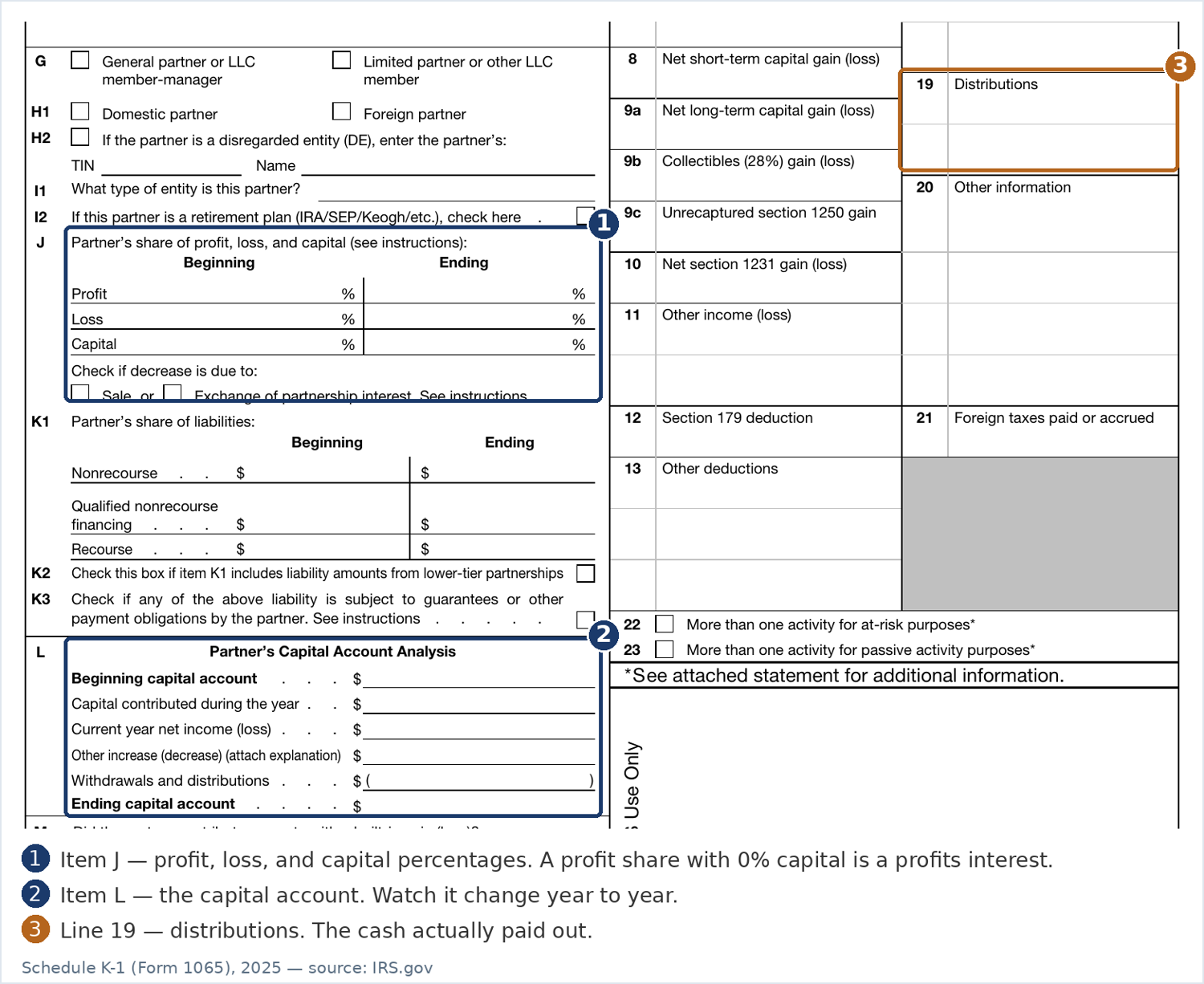
A partnership is simply a business owned by more than one person. An S-corporation is a small business set up to pass its profits and losses directly to the owners rather than being taxed at the business level. Most LLCs are taxed as one or the other. If your spouse owns a share of any of these — even a small share — that ownership shows up on a document called a Schedule K-1 each year.
Definition — Schedule K-1
The annual statement a partnership or S-corporation sends each owner showing that owner’s share of the business’s income, deductions, and credits for the year. It is not a paycheck and not a bank statement — it reports what the business earned on the owner’s behalf, whether or not any cash was actually paid out.
The K-1 is fundamentally different from a W-2 or a Schedule C number — and the single most important thing to understand about it is this: K-1 income may have nothing to do with money the owner actually received. A K-1 can show significant taxable income in a year the owner took zero distributions — no cash paid out at all — because the business kept the profit inside. That’s legal. And in a divorce, it cuts in two very different directions.
How this cuts both ways
Income never received: A spouse may be paying taxes on business income they never actually got as cash — which is relevant when calculating ability to pay support.
Earnings being hidden: A business can deliberately retain earnings to keep cash out of sight during divorce proceedings, while real value builds up inside the ownership stake. Neither scenario should be taken at face value without looking underneath the K-1 number.
From My Practice
I’m currently working with a client who held a partnership interest in a national consulting firm before he married. He indicated the original stake was acquired prior to the marriage — but in Texas, all property is presumed community unless it can be proven otherwise by clear and convincing evidence. The burden is on the spouse claiming separate property, and that burden is real.
Fortunately, he had his K-1s going back to before the marriage. That’s not always the case — K-1s report ownership as of December 31 of a given year, and marriage dates don’t always line up neatly with that year-end snapshot. When the documentation exists, though, K-1s are one of the cleanest ways to establish what was owned before the marriage and track what changed during it.
In this case, the ownership interest increased during the marriage — and how it increased matters as much as the fact that it did. He earned guaranteed payments from the partnership — the partnership version of a salary — which are community income in Texas, and used that salary to acquire additional partnership units over time. Funds from marital income used to buy an asset make that asset marital property, regardless of how the original interest is characterized. The increase in ownership stake belongs to the marital estate.
What we’re working through now is establishing the baseline — what he owned on the day of the marriage — and measuring the growth from there. When the K-1s exist and the dates line up cleanly, the math is straightforward. When they don’t, there’s a practical middle ground: take the K-1 from the year before the marriage and the K-1 from the year of the marriage, and prorate the difference based on the number of calendar days he was actually married that year. It’s not a perfect science, but it’s a defensible approach both sides can often agree to.
Any time a partnership or S-corporation interest appears on a return, the first question in a divorce should be when it was acquired and how it grew. The K-1 history is where that answer lives.
Definition — Distributions
Cash or property a partnership or S-corporation actually pays out to an owner. Distributions aren’t a deduction for the business and aren’t income to the owner, as long as they don’t exceed the owner’s basis — the income was already taxed through the K-1. They’re the cash side of the K-1, and they’re reported separately from income, on the K-1 itself and on Schedule K of the business return.
Three K-1 numbers to read together
Income — the owner’s share of what the business earned. This is what gets taxed.
Distributions — what was actually paid out to the owner. This is the cash.
Capital account — what the owner’s stake is carried at inside the business. When income is high and distributions are low, this is where the money is building up. Watch how it changes from year to year.
How Does an S-Corporation Owner Actually Get Paid — and Where Is the Rest?
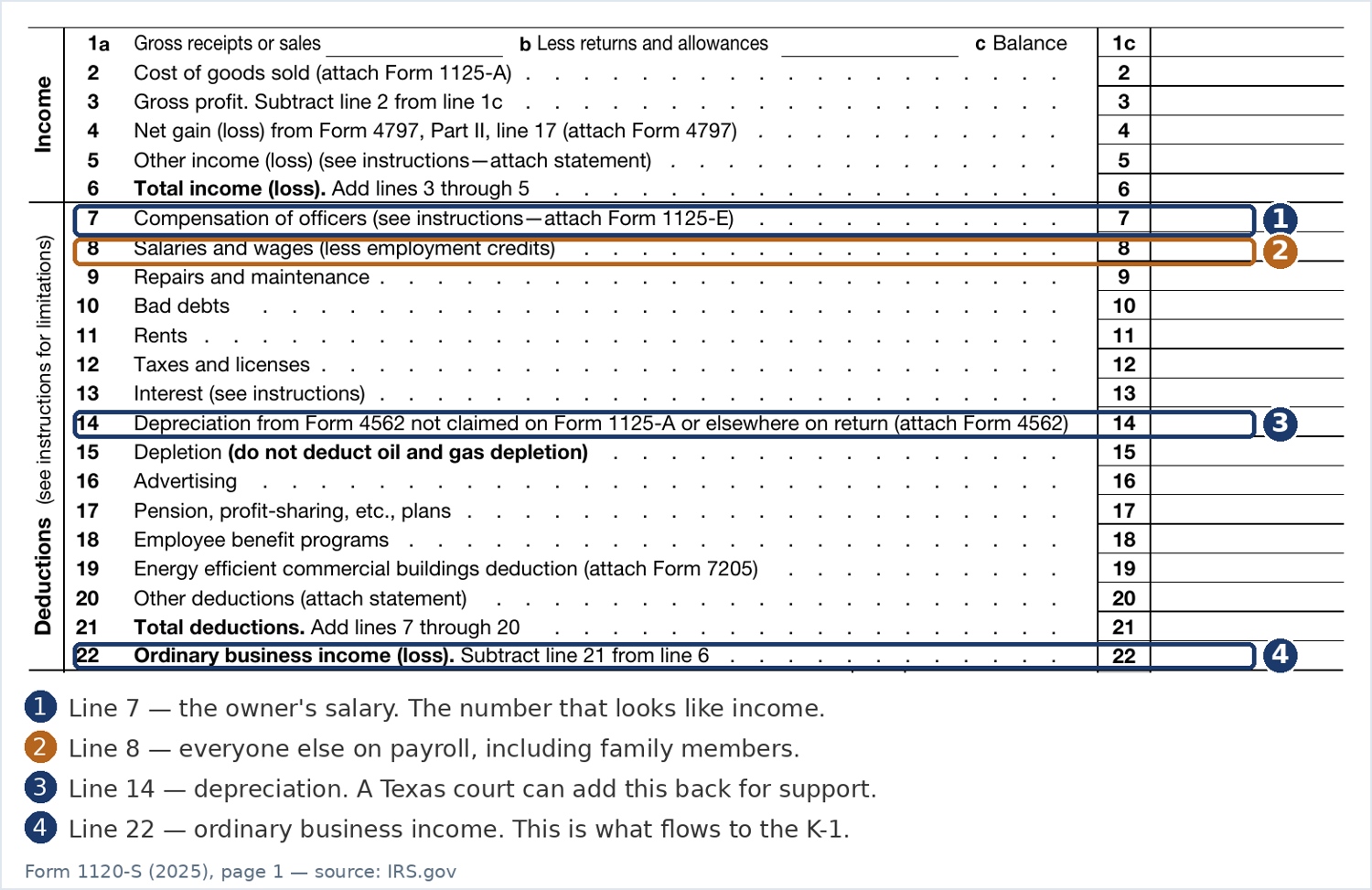
Where to look: Form 1120-S, page 1: line 7 (compensation of officers) and line 8 (other salaries and wages). Schedule K, line 16d (distributions). Schedule L (balance sheet). The owner’s W-2 and K-1 for the same year.
Definition — S-Corporation
A corporation (or an LLC) that has elected to pass its profits through to its owners instead of paying tax itself. The owners report their share on their personal returns whether or not it was paid out. An owner who works in the business must be paid a salary through payroll; profit beyond that comes out as distributions.
Definition — Reasonable Compensation
The salary the IRS requires an S-corporation to pay an owner who works in the business — roughly what it would cost to hire someone else for the same job. It’s a floor, not a formula. Because every dollar above it can come out as a distribution free of payroll tax, owner salaries tend to sit right at it.
An S-corporation owner gets paid two ways, and the split between them is the whole story. The first is a W-2 salary from the company, which is subject to payroll taxes. The second is distributions of profit, which are not. The IRS requires the salary to be “reasonable” for the work the owner does — but reasonable is a range, and every dollar moved from salary to distribution saves the owner payroll tax. So salaries tend to sit at the low end of reasonable, and the rest comes out as distributions.
That matters in a divorce because the salary is the number that looks like income. It’s on the W-2. It’s on line 1 of the 1040. If someone tells you what the owner “makes,” that’s usually the figure they mean. The owner’s actual income is the salary plus the distributions plus whatever profit the company kept — and the last two are nowhere on page one of the personal return.
Add the three together
For support and for understanding the household’s real cash flow, the owner’s income from an S-corp is: W-2 salary + distributions + profit retained in the company. The first is on the W-2, the second is on Schedule K of the 1120-S and on the K-1, the third is the K-1 income minus the distributions. A salary that hasn’t moved in five years while distributions doubled is a pattern, not a coincidence.
The other place to look on an S-corp return is who else is being paid. Line 8 is salaries and wages for everyone who isn’t an officer. Family members on the payroll aren’t unusual, and they aren’t automatically a problem — but they need to be doing real work.
From My Practice
I was working with a couple in a collaborative divorce. The husband had an S-corp, and when I pulled the business return, I noticed tens of thousands of dollars in wages being paid to his children. They were school-age, living with their mother, and nowhere near the business — he had moved out of state for work.
The wages were being funneled into 529 college savings plans for the kids. As a standalone tax strategy, paying your children through a family business isn’t automatically illegal — but it requires the child to be performing legitimate, documentable work. Neither child was performing any work for the business.
The effect on the divorce was significant. Every dollar of those wages ran through the S-corp as a business expense, reducing the net income flowing to the husband’s K-1. For purposes of calculating spousal support and child support, his available income looked tens of thousands of dollars smaller than it actually was.
When I raised it, the husband felt I’d chosen a side. To be fair, this wasn’t the only thing I’d called into question — there were several other figures I’d flagged throughout the process. But the cumulative effect was that I eventually lost my neutrality in his eyes. That’s a cost I’ve accepted more than once — because the alternative is letting numbers stand that I know aren’t right.
What Happens When a C-Corporation Keeps the Money?
Where to look: Form 1120, page 1, line 12 (compensation of officers). Schedule L — cash, investments, and retained earnings (line 25). Schedule M-2. The owner’s personal return shows only W-2 wages and any dividends on Schedule B.
Definition — C-Corporation
A corporation that pays its own income tax on its profits. Its owners are taxed only on what the company pays them — salary and dividends. Profit the company keeps is taxed once at the corporate level now, and again at the owner level later, when it’s finally distributed.
A C-corporation is the one business type that keeps its finances almost entirely off the owner’s personal return. The company pays its own income tax. The owner is taxed only on what the company pays them — a salary, reported on a W-2, and dividends, reported on Schedule B. Profit the company doesn’t pay out stays inside as retained earnings, and nothing about it appears on the 1040.
That gives an owner enormous control over what their personal return shows. Take a modest salary, pay no dividends, and the personal return looks like a mid-level employee’s — while the company accumulates cash, investments, or real estate year after year. None of it is hidden, exactly. It’s just on a different return.
Where the value is
Schedule L of Form 1120 is the company’s balance sheet. Read it across three to five years. Rising cash, rising investments, rising retained earnings, and a flat owner salary means the value of the marriage’s stake in that company has been growing while the household’s reported income stood still. If the stock is community property, that growth is part of the marital estate.
From My Practice
Retained earnings can hide a tax bill as easily as they hide cash. I worked with a client whose spouse owned a C-corporation that hadn’t been distributing its profits. The company paid its own corporate tax each year, but the owner paid nothing personally — because nothing was paid out to him. Instead, the company kept the money inside and invested it in precious metals. On the surface it looked like a conservative decision: a business building a reserve.
But the owner’s tax hadn’t gone away. It had been deferred. Every dollar sitting in those metals carried a liability that would come due the moment it was sold and distributed — and the longer the metals appreciated, the larger that liability grew. The business was worth less than its balance sheet said, by the amount of tax that hadn’t been paid yet.
That matters in a divorce because the business gets valued and divided, and the spouse who keeps it inherits the deferred bill. If the valuation uses the gross number, the other spouse gets paid out on value that doesn’t exist after tax. In that case we netted the embedded tax out of the valuation — the same way you’d net depreciation recapture out of a rental property — and the division reflected what the business was actually worth.
It’s a pattern worth watching for any time a business is holding assets instead of paying out profits: real estate, securities, metals, or an unusually large cash balance. The balance sheet shows the assets. It doesn’t show the tax waiting on the other side of them.
What Is a Profits Interest, and Why Does It Look Like Nothing on a K-1?
Where to look: A partnership K-1 where Item J shows a profit percentage but a zero capital percentage, and Item L shows a capital account at or near zero. The partnership or operating agreement describes the grant and its vesting schedule.
Some ownership doesn’t come from buying in. It comes from being granted a share of the future. It’s one of the easiest things to overlook on a K-1, because the form is designed to show what someone has, not what they’re entitled to.
The K-1 that looks like nothing: profits interests
In partnerships and LLCs, an owner is sometimes given a profits interest. It’s common in private equity funds, law and consulting firms, real estate deals, and startups. A profits interest is a share of the business’s future profits and growth — but no share of what the business was already worth on the day it was granted. On a partnership K-1, it shows up as a profit percentage in Item J with a capital percentage of zero. The capital account in Item L may start at nothing.
On paper it looks worthless. It isn’t. If the business grows, that interest can be worth more than everything else on the return combined. And if it was granted during the marriage, in Texas it is generally community property. One caveat: if vesting requires continued work after the divorce, the part tied to that future work may be treated as separate — the same time-based split Texas uses for unvested stock options and restricted stock (Family Code §3.007). The vesting schedule is a question to raise, not a reason to ignore the interest.
When a K-1 shows a profit share without a matching capital share, stop and ask three questions. What is it? When was it granted? What would it be worth if the business were sold today?
What Can a Texas Court Add Back When Calculating Support?
Where to look: Texas Family Code §154.062 (net resources) and §154.065 (self-employment income). On the business return: the depreciation line and any expense category that spikes during the separation.
Everything above describes how reported business income can be shaped. Here is the part that matters most for a Texas reader: the court doesn’t have to accept the shaped number.
Texas calculates child support from a parent’s net resources. For a business owner, that starts with self-employment income: business receipts less the ordinary and necessary expenses required to produce them. But §154.065(b) gives the court specific authority to exclude certain expenses from that calculation. The statute names “depreciation, tax credits, or any other business expenses shown by the evidence to be inappropriate.” In plain terms: depreciation can be added back. So can any deduction a judge is persuaded shouldn’t count against the children.
What that means in practice
The lingerie charge, the children on payroll, the personal vehicle, the prepaid expenses — every example in this guide is a §154.065(b) argument. The business return is allowed to say what it says for IRS purposes. The support calculation is allowed to say something different. Making that argument requires the source documents, which is why the request list above matters.
One limit to know: the guideline percentages apply to the first $11,700 per month of net resources. (The cap was raised from $9,200 on September 1, 2025.) Above that, additional support requires proof of the child’s needs. So how business income is reported matters most for owners near or below that line.
Is a Tax Return the Same as a Business Valuation?
Where to look: Everything above, read together across multiple years, by someone qualified to value a business. The return is an input, not the answer.
A tax return tells you what a business reported. It doesn’t tell you what the business is worth, and in a divorce the two questions are separate. Value is what someone would pay for the owner’s interest. That depends on the real earnings, the real assets, and the real risks — none of which the return is designed to show plainly.
A valuation starts by normalizing the numbers. That means adding back personal expenses that ran through the business, adjusting the owner’s salary to what it would cost to hire someone else for the job, and removing one-time items. Then it accounts for what’s sitting inside the company — retained earnings, investments, equipment — and for the tax still owed on them. The deferred tax in the C-corporation story is exactly this kind of adjustment. The business was worth less than its balance sheet by the tax that hadn’t been paid yet.
Definition — Goodwill
The value of a business beyond its tangible assets: reputation, relationships, systems, and the expectation of future customers. Texas splits it in two. Personal goodwill depends on the owner as a person — a physician’s or an attorney’s reputation. Enterprise goodwill belongs to the business itself and would survive the owner leaving.
Texas divides enterprise goodwill, not personal goodwill
Personal goodwill is not divisible community property in Texas. Enterprise goodwill is. Separating the two is one of the main jobs of a valuation in a Texas divorce. It’s also why two businesses with the same profits can be worth very different amounts in a settlement.
When business income or value is in play, this is where I recommend a credentialed business valuation expert or a forensic CPA alongside the legal team. Reading the return is how you know what questions to ask. The valuation is how those questions get answered in a form a court or a mediator will rely on.
The Business Return Is Where the Answers Are
The thing I want every client married to a business owner to understand is this: the personal return is the summary, and the summary was written by the business. That isn’t an accusation. It’s just how the system works. The verification you’d get from an employer’s W-2 doesn’t exist here, and the only substitute is the business’s own documents, read across several years.
Most of what I find isn’t fraud. It’s choices — legal, ordinary, and made with the owner’s interests in mind. The job is to see those choices for what they are, put the real numbers back, and make sure the settlement is built on them.
Five things to remember
- →Know which return you’re looking at. Schedule C, Form 1065, Form 1120-S, or Form 1120 — the entity type decides where the income is and what to request.
- →Get the whole business return, not the page that reaches the 1040. Schedules L, M-1, and M-2 are where the balance sheet and the adjustments live.
- →For an S-corp, add salary, distributions, and retained profit together. The salary alone is the smallest of the three by design.
- →The statements are the evidence. A category total on the return can’t tell you what the money bought. Three to five years of bank and credit card statements can.
- →In Texas, the court can add it back. Depreciation and inappropriate expenses don’t have to count against support — but someone has to make the argument, with documents.
Where to start
Find out the entity type — it’s at the top of the business return, or on the Texas Comptroller’s franchise tax search. Then give your attorney the request list from this guide. If the business is any size at all, ask early about a valuation expert or forensic CPA; the cost of one is almost always smaller than the cost of dividing a business on the wrong number.
Keep reading
→ How to Read a Tax Return When You’ve Never Had To→ Community vs. Separate Property in Texas: What’s Really Yours→ The Five Ways to Resolve a Divorce in Texas→ Retirement, Pensions & Stock Options: The Money Most Likely to Slip Away
Frequently asked questions
How do I find out what business income my spouse really has in a divorce?
Start with the full business return — every page and schedule, not just the K-1 or Schedule C that reaches the personal return — for three to five years. Then get the business’s bank and credit card statements for the same years. The return shows totals by category; the statements show what the money actually bought. For an S-corporation, add up the owner’s W-2 salary, distributions, and whatever profit was left inside the company. For a C-corporation, look at the balance sheet for retained earnings and investments the owner never took as salary or dividends.
What is the difference between an S-corp salary and a distribution, and why does it matter for support?
An S-corporation owner is paid two ways: a W-2 salary, which is subject to payroll taxes, and distributions of profit, which are not. That creates an incentive to keep the salary low and take the rest as distributions. For spousal and child support, the owner’s available income is the salary plus the distributions plus any profit retained in the company — not the salary alone. The salary is on page one of Form 1120-S; distributions are on Schedule K.
Can my spouse reduce reported business income to lower child support in Texas?
A business owner can legally lower reported profit by prepaying expenses, accelerating deductions, increasing retirement contributions, deferring billing, or running personal costs through the business. But Texas Family Code §154.065(b) lets the court exclude from self-employment income any depreciation, tax credits, or other business expenses shown to be inappropriate when calculating child support. The guideline percentages apply to the first $11,700 per month of net resources (as of September 2025), so how income is reported matters most for earners near or below that line.
What is a Schedule K-1, and does it show what my spouse was actually paid?
No. A K-1 is the annual statement a partnership, multi-owner LLC, or S-corporation sends each owner showing that owner’s share of the business’s income, deductions, and credits. It reports what the business earned on the owner’s behalf, whether or not any cash was paid out. An owner can have significant K-1 income and zero distributions, or large distributions and little K-1 income. Distributions are reported separately on the K-1 and on the business return.
What is a profits interest, and how is it treated in a Texas divorce?
A profits interest is an ownership stake in a partnership or LLC that entitles the holder to a share of future profits and growth, but not to the value the business already had when the interest was granted. On a partnership K-1 it typically shows a profit percentage with a zero capital percentage and a capital account that starts at nothing. It can look worthless on paper and be worth a great deal. If it was granted during the marriage, it is generally community property in Texas. If vesting requires continued work after the divorce, the portion tied to that future work may be treated as separate, the way Texas apportions unvested stock options under Family Code §3.007.
Do retained earnings in a C-corporation count in a Texas divorce?
Yes. Profits a C-corporation keeps rather than paying out as salary or dividends build up inside the company as retained earnings, and if the stock is community property, that value is part of the marital estate. The business is worth more than the owner’s personal return suggests — but less than its balance sheet says, because the owner’s tax on those earnings has been deferred, not avoided. A proper valuation nets that embedded tax out.
What documents should I request for a business in a divorce?
The complete business tax returns for three to five years, including Schedule L (balance sheet) and Schedules M-1 and M-2; every K-1 the business issued, not just your spouse’s; the internal financial statements (profit and loss, balance sheet, general ledger); business bank and credit card statements; payroll reports and W-2s; the depreciation schedule; any shareholder or partner loan records; and the operating, partnership, or shareholder agreement. In Texas, the franchise tax reports filed with the Comptroller are a useful cross-check.
Is a business’s goodwill divided in a Texas divorce?
Only part of it. Texas distinguishes personal goodwill — value that depends on the owner personally, such as a professional’s reputation and relationships — from enterprise goodwill, which belongs to the business itself. Personal goodwill is not divisible community property in Texas; enterprise goodwill is. Separating the two is one of the main jobs of a business valuation in a Texas divorce, and it is why two businesses with identical profits can be worth very different amounts in a settlement.
Kyle Eaton is a Certified Divorce Financial Analyst (CDFA®) and CERTIFIED FINANCIAL PLANNER™ professional in Denton, Texas. He holds a master’s degree in family financial planning from Oklahoma State University with graduate-level coursework in federal income tax, and has worked in financial planning since 2005. He is not an attorney or a CPA. This guide is written for educational purposes only — it is not legal advice, tax advice, or financial advice for your specific situation. The characterization, division, and taxation of marital property involve legal and tax questions that require your own qualified attorney and CPA. Nothing here should be relied upon as a substitute for professional counsel in your divorce.